
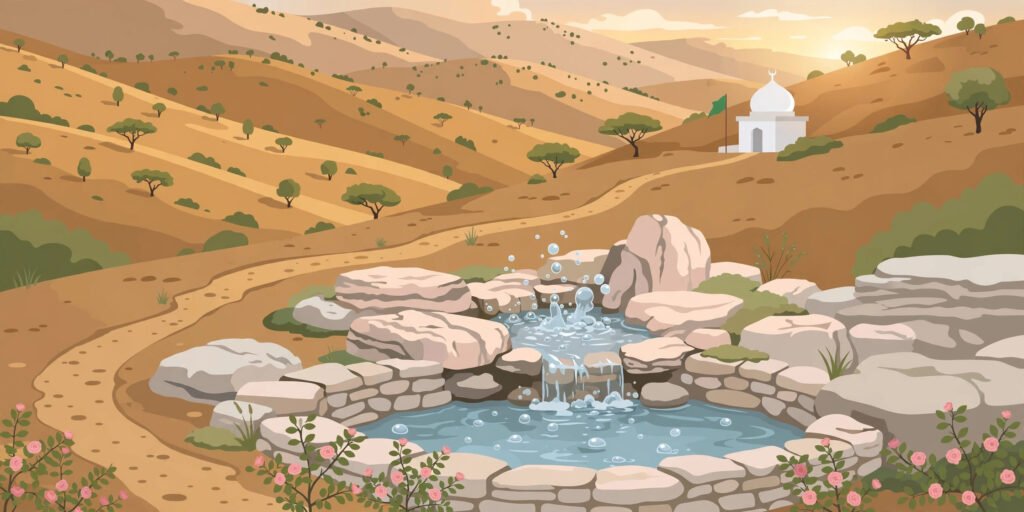
Why Is It Called Choa Saidan Shah? The Spring of the Saint
Choa Saidan Shah is named after a saint and a spring. “Choa” means “spring” in Punjabi and Pothohari, and “Saidan Shah” honours the Sufi saint Saidan Shah Shirazi, whose shrine still stands behind the town’s main bazaar. Put together, the name means, in plain words, “the spring of Saidan Shah” — a name that has described this Salt Range town for centuries.
The name is more than a label. It tells you what this place was before it became a tehsil headquarters: a watering stop in a dry, hilly landscape, made memorable by a holy man and the sweet water that appeared near him. To understand why the town is called Choa Saidan Shah, you have to understand both halves of the name — the spring and the saint.
What does “Choa” mean?
In Punjabi and in the Pothohari dialect spoken across the Pothohar plateau, “choa” (چوآ) means a spring — a place where water rises naturally out of the ground. In the Salt Range, where Choa Saidan Shah sits at an elevation of about 676 metres, springs mattered enormously. The hills around the town are dry for much of the year, and a reliable spring could decide where people settled, where travellers rested, and where a village grew into a town.
The town sits in a bowl-shaped valley ringed by hills, trees and orchards. Springs and small streams have always been part of that landscape, and the town’s name preserves the memory of the most famous of them. When people in the area said “Choa”, they did not mean just any water — they meant the spring that everyone knew, the one connected to the saint.
Who was Saidan Shah Shirazi?
Saidan Shah Shirazi was a Sufi saint whose name the town still carries. His shrine stands behind the main bazaar of Choa Saidan Shah, in the heart of the old town, and it remains a place of respect and visit for local people. The town’s annual urs — the traditional gathering held in his memory — is traditionally observed in April, and it continues to draw people from the town and the surrounding villages.
What is known about him comes down through local tradition rather than through a detailed written biography, and that is true of many saints of the Salt Range and Pothohar region. He is remembered as a holy man who settled here, and the town grew up around his resting place. The “Shirazi” in his name points to Shiraz, the historic city in Persia, which is where, according to the tradition, his family origins lay — a reminder that the Salt Range has long sat on the routes that connected Central Asia, Persia and the Punjab plains.
What does local tradition say about the spring?
Local tradition says that the spring appeared through the saint’s blessing. The story, as it is told in the town, is that Saidan Shah struck the ground with his staff and sweet water sprang up where there had been none — water that travellers and residents could drink. That is why the spring, and then the settlement around it, took his name.
This story should be read the way such traditions are meant to be read: as the community’s own account of why its home matters, passed down by word of mouth over generations. There is no written record that can confirm the details of the staff and the spring, and honest local history says so plainly. But the story itself is a real part of the town’s heritage. It explains the name, it explains why the shrine and the water are spoken of together, and it has shaped how people here think about their town for as long as anyone can remember.
What can be said with confidence is this: the spring was real and important enough to name a settlement after, the saint was real enough that his shrine still anchors the old town, and the two facts together — water and a holy man — gave Choa Saidan Shah a name that has survived every change the town has seen since.
How did a spring and a shrine become a town?
A named spring in a dry range becomes a landmark, and landmarks become meeting points. Travellers on the old routes through the Salt Range knew the spring of Saidan Shah as a place to rest and water their animals. Over time, a settlement formed around it: first the shrine and its keepers, then shops, then houses, then a bazaar.
Today Choa Saidan Shah is the headquarters of its tehsil in Chakwal District, with a town population of around 40,000 and a tehsil population of about 167,537 (2023 census). It sits roughly 35 kilometres south of Chakwal city on the Chakwal–Khewra road, about 27 kilometres from the M2 motorway, and only around 6 kilometres from the Katas Raj Temples. The town is also known for its roses and perfumes, a tradition noted by the Punjab tourism authorities. But the name still points back to the beginning: a spring, and a saint.
The shrine’s position tells the same story. It stands behind the main bazaar — not on the edge of town, but at its centre, where the oldest part of the settlement grew. The bazaar, the shrine and the memory of the spring are all in the same small area, which is exactly what you would expect if the town grew outward from that spot.
Why does the name still matter?
Place names in the Salt Range are often practical descriptions, and Choa Saidan Shah is one of the clearest examples. The name is a short history lesson: it records the water that made settlement possible and the saint whose memory gave the place its identity. In a district where many towns are named after founders, tribes or landmarks, this one is named after a blessing.
For visitors, the name is also a useful guide. If you come to Choa Saidan Shah, the two things the name points to — the shrine behind the bazaar and the spring tradition — are still the most meaningful places to start. The shrine is easy to find, the bazaar around it is the town’s living centre, and the story of the spring is one that local people are happy to tell, each in their own words.
For residents, the name is a point of pride. It connects the town to the Sufi traditions of the Punjab, to the old travelling routes of the Salt Range, and to a history that predates the district boundaries drawn in modern times. Chakwal became a district in 1985, but the spring of Saidan Shah was already old by then.
Visiting the shrine and the spring today
If you plan to visit, a few practical points help. The shrine is in the old town, behind the main bazaar, and is best reached on foot once you are in the bazaar area. Dress modestly and behave respectfully, as you would at any shrine in Punjab — cover your head if that is the local custom at the site, remove your shoes where required, and keep your voice low inside.
The traditional urs in April is the liveliest time to experience the shrine’s place in town life, but it is also the busiest, so check locally before travelling for it. At other times of year the shrine is quiet, and the bazaar around it is the better place to feel the town’s everyday rhythm.
Do not expect a signposted “spring” with a ticket counter. The spring of the story is part of the town’s landscape and memory rather than a developed tourist site, and the exact spot is something local people can point out. Ask in the bazaar, and you will usually find someone glad to show you. If you want the full picture, combine the visit with Katas Raj Temples, about 6 kilometres away — the sacred pool there is the district’s other great water story, and the two sites together explain why water and worship are so closely tied in the Salt Range.
Frequently asked questions
Why is it called Choa Saidan Shah?
The town is named after a spring (“choa” in Punjabi and Pothohari) and the Sufi saint Saidan Shah Shirazi, whose shrine stands behind the main bazaar. The name means “the spring of Saidan Shah”.
What does “Choa” mean?
“Choa” (چوآ) means a spring — a natural source of water rising from the ground — in Punjabi and the Pothohari dialect of the Pothohar plateau.
Who was Saidan Shah Shirazi?
He was a Sufi saint remembered in local tradition as the holy man after whom the town is named. His shrine is in the old town behind the main bazaar, and his annual urs is traditionally held in April.
Is the story of the spring true?
Local tradition says the spring appeared through the saint’s blessing when he struck the ground with his staff. The story is a treasured local tradition rather than a documented historical event, and it is told here as tradition, not as established fact.
Where is the shrine of Saidan Shah?
The shrine stands behind the main bazaar in the old part of Choa Saidan Shah, in Chakwal District, Punjab. It is best reached on foot from the bazaar.
—
Sources and notes: the meaning of “choa” as spring in Punjabi/Pothohari, the shrine of Saidan Shah Shirazi behind the main bazaar, the traditional April urs, the town’s elevation of about 676 metres, its bowl-shaped valley, the 2023 census figures and the distances to Chakwal, the M2 and Katas Raj follow the district’s published facts, including the Punjab tourism department’s description of the town. The story of the spring is presented as local tradition, as it is told in the town; no written record confirms its details. For current conditions and urs dates, check locally before travelling.