
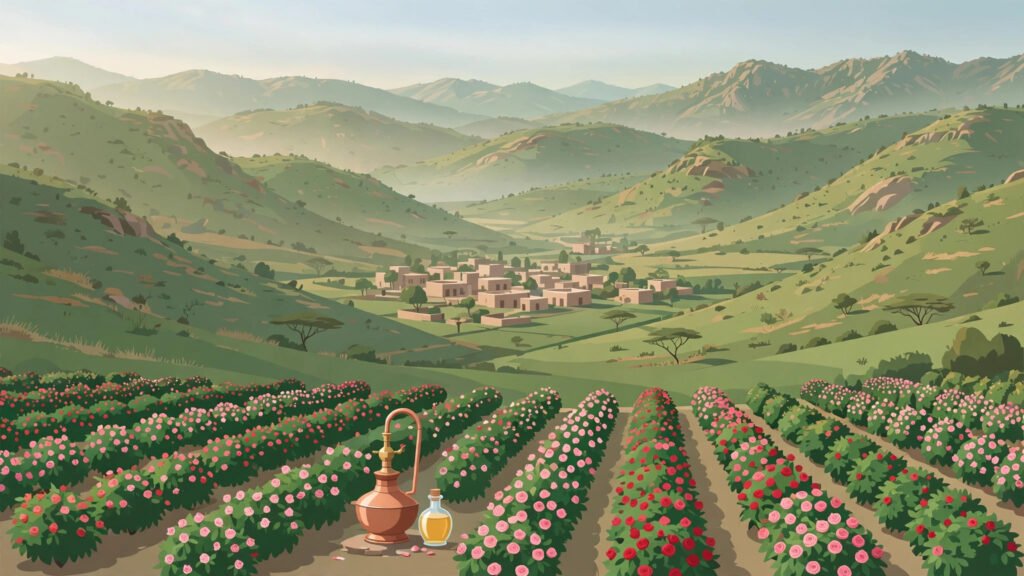
The Roses and Perfume Tradition of Choa Saidan Shah
Choa Saidan Shah is famous for its roses and its perfume. In a town best known to visitors for the Katas Raj Temples and the Salt Range hills, the scent of roses is the quieter half of its identity — orchards and gardens in a bowl-shaped valley, and a perfume tradition that the Punjab tourism department itself notes when it describes the town. This guide explains where the roses come from, how the perfume is made, and how a visitor can experience both.
Why does Choa Saidan Shah grow such good roses?
The answer starts with water and land. Choa Saidan Shah sits in a bowl-shaped valley at about 676 metres above sea level, ringed by the hills of the Salt Range. The town takes its name from a spring — “choa” means spring in the local Pothohari speech — and springs and wells have watered its gardens for generations. Rose bushes need steady water, good drainage and plenty of sun, and the valley’s sloping ground gives them all three: water runs through, it does not sit and rot the roots, and the open sky above the bowl gives long hours of sunlight.
The climate helps too. Winters in the valley are cool and the summers are hot but not as punishing as on the plains below, and roses flower most generously in the mild months of spring and autumn. Local growers have learned over generations which varieties suit this ground — the hardy, strongly scented types that survive a Salt Range winter and still throw out masses of bloom when the weather turns. The result is a landscape where roses are not a novelty but a normal part of the town: in home gardens, in small orchards on the valley floor, and along the edges of fields.
What is the perfume tradition of Choa Saidan Shah?
The town’s perfume tradition is the attar trade — the slow distillation of rose petals into fragrant oil. Attar is one of the oldest forms of perfume in South Asia: fresh petals are steeped and gently heated so that their scent rises with steam, then cooled and collected as a concentrated oil. A small amount goes a long way, and the oil keeps its fragrance for months when it is stored properly.
Visitors should understand what this tradition is and what it is not. It is a craft tradition, passed down through families and small workshops, not a factory industry. The work is seasonal — it follows the flowering of the roses — and much of it happens at a small scale, in the homes and courtyards of the people who grow the flowers. That small scale is part of the point: the perfume of Choa Saidan Shah is a local product, made from local flowers, and the town’s reputation for it has travelled further than the bottles themselves.
The Punjab tourism department’s own description of the town mentions its fame for roses and perfumes, and that official recognition matters. It tells visitors that this is not a recent marketing claim but a settled part of how the town is known — the way a place earns a reputation over decades, not a season.
When is the best time to see the roses?
Spring is the season to come for the roses. From roughly March into April, the valley is at its greenest and the rose bushes are in full flower. This is also the season of the annual urs at the shrine of Saidan Shah behind the main bazaar, traditionally held in April, so a spring visit can combine the roses, the shrine and the town at its liveliest.
Autumn brings a second, smaller flush of flowers, and the weather in October and November is among the most comfortable of the year for walking the valley. Summer is hot and the flowering thins out, while winter is quiet — the bushes rest, the hills turn brown, and the town belongs to its residents again. Any season has its own charm, but if roses are the reason for the trip, spring is the time.
How is rose attar made?
The traditional method is simple to describe and slow to do well. Fresh rose petals are gathered early in the morning, when their scent is strongest, and placed in a still with water. Gentle heat turns the water to steam, the steam carries the scent of the petals with it, and the steam is cooled back into liquid — water and a thin layer of fragrant oil. The oil is skimmed off, and the scented water that remains is itself used as rose water.
Two things decide the quality. The first is the freshness of the petals: they must be picked and distilled the same day, which is why the work happens close to the gardens. The second is patience: good attar is not rushed, and the best makers judge by smell, not by the clock. Visitors who meet a local maker should ask how the process works rather than expecting a factory tour — this is a household craft, and the people who practise it are usually glad to talk about it, even if there is no shop to show.
Can visitors buy rose perfume in Choa Saidan Shah?
Yes, in the town’s bazaar — but come with the right expectations. The bazaar around the main market sells the everyday goods of a small Punjab town, and among them you will find small bottles of attar and rose water from local makers. There is no single famous shop to name, and prices and availability change with the season, so ask locally and compare before you buy.
A few practical tips help. Buy in the flowering season, when the stock is freshest. Smell before you buy, and remember that real attar is strong — a drop on the wrist should last for hours. Ask the seller what it is made from and how it was made; an honest maker will tell you plainly. And buy from the town’s own sellers rather than from hawkers at the tourist sites outside it, where the same bottle may cost more and be of uncertain origin.
It is also worth remembering that the roses themselves are the souvenir that costs nothing. A slow walk through the valley in spring, past gardens and orchards with the hills behind them, is the experience the perfume is trying to bottle — and it is free.
What do the roses mean to the town?
For the people of Choa Saidan Shah, the roses are more than a product. The town’s story begins with a spring of sweet water, and the gardens that grew from that water are part of its identity — the reason the town is described as green and fragrant in a region otherwise known for salt, coal and stone. Roses soften that harder image: the Salt Range gives the district its minerals and its mines, but the valley floor gives it flowers.
That matters for visitors too. Choa Saidan Shah is often treated as a stop on the way to somewhere else — the temples at Katas Raj, the salt mine at Khewra, the lake at Kallar Kahar. The roses give the town a reason to be a destination in its own right, and a reason to slow down. Stay a morning, walk the valley, visit the shrine and the bazaar, and you will understand the town better than any day trip to the temples alone can teach you.
How does a visit to the rose gardens fit into a day in Choa Saidan Shah?
Easily. The town is small, and the valley is walkable. Start in the main bazaar, visit the shrine of Saidan Shah behind it, then walk out towards the gardens and orchards on the valley floor. In spring the roses are the walk’s reward; in any season the bowl of hills around the town is the view. Allow a couple of hours for the town itself, then drive the six kilometres to the Katas Raj Temples for the late morning, and finish the day at Khewra Salt Mine, eight to ten kilometres south.
If you are coming from Chakwal city, the town is about 35 kilometres south on the Chakwal–Khewra road; from Islamabad or Lahore, the M2 motorway to the Kallar Kahar interchange is the usual route. The roses are not a separate attraction with a gate and a ticket — they are woven into the town itself, which is why the best way to see them is on foot, slowly, with time to stop and look.
Frequently asked questions
Why is Choa Saidan Shah famous for roses and perfume?
The town sits in a spring-watered, bowl-shaped valley in the Salt Range where roses have been grown for generations, and its attar — rose-petal perfume oil — is a long-standing local craft. The Punjab tourism department notes the town’s fame for roses and perfumes.
When is the best time to see the roses in Choa Saidan Shah?
Spring, roughly March to April, when the rose bushes are in full flower and the valley is at its greenest. Autumn brings a second, smaller flowering, and the weather is very pleasant then too.
What is attar, and how is it made?
Attar is a concentrated perfume oil made by gently heating fresh rose petals with water so their scent rises with the steam, then cooling and collecting the oil. It is a traditional household craft in the town, done close to the gardens in the flowering season.
Can I buy rose perfume in Choa Saidan Shah?
Yes — small bottles of attar and rose water are sold in the town’s bazaar. Buy in the flowering season when stock is freshest, smell before you buy, and ask the seller how it was made.
Sources and notes: the town’s fame for roses and perfumes, its bowl-shaped valley, its elevation of about 676 metres, and its spring-watered gardens follow the district’s published facts, including the Punjab tourism department’s description of the town. The attar-making process is described in general traditional terms; no shop, maker, price or timetable is named, because these change — ask locally. For current availability and conditions, check locally before travelling.